How a 10-Second Knee Test Got Us Down the Grand Canyon at 66
A Cleveland Clinic sports doctor explains how a little strap below the kneecap changes the load on the spot that hurts going down. Here's what happened when I tried it.
By Ray Hollis · Updated October 25, 2026 · 6 min read · Healthy Aging
"Be Realistic"
I'm Ray. I'm 66. I spent 31 years earning retirement.
By the end of the first year, every plan my wife Ellen and I had made had shrunk to fit my knee.
The list had been on our fridge for a decade. The Grand Canyon, hiking down below the rim. The stairs in the Amalfi towns. Walking the Camino.
My knee had been "acting up" for a few years. Nothing dramatic. Just enough that everybody's advice made sense. "You're not 40 anymore." "Be realistic."
So I was.
The hike below the rim became "we'll see it from the top." The Camino became "maybe a river cruise."
Ellen never argued. She just said, "Whatever works for your knee." That was worse than if she'd argued.
One night I did some math I didn't like. If we're lucky, we get maybe ten good years of big trips. I'd spent the first one booking scenic drives.
I thought it was just age. It wasn't.
Why Did It Only Hurt Going Down?
Here's the part that never made sense to me.
My knee was fine going up the stairs. Coming down, it hurt. Every single time.
And always in the same spot. Right at the front of the knee, just below the kneecap.
It hurt stepping off a curb. It hurt getting up from a low chair. It hurt getting up off the floor.
But walking up a flight of stairs? Fine.
If this was really age, why would it pick a direction?
Age doesn't do that. Something else was going on. I just never asked what.
I'm not the only one who missed it. Donald, 68, wrote to the company that makes the strap I'll show you in a minute:
"Going up stairs was always fine… Coming down was the whole problem. That's when the pain hit, every single step."
Donald W., 68
The Spot That Takes Your Weight on Every Step Down
It turns out there's a simple reason.
When you walk up stairs, the big muscles in your thigh do most of the work.
When you walk down, it's different. Every step down, your body weight drives through the tendon just below your kneecap. That tendon is holding you back from dropping too fast.
Same thing when you push yourself up from a low seat with your knee bent.
That's why those moves find it. And climbing up doesn't.
So it wasn't my whole knee that was the problem. It was one spot. The one that takes the load on the way down.
I'd been calling it age because age is something you don't have to fix.
Everything in My Drawer Had the Same Flaw
If you've had knee trouble for a while, you probably have a drawer like mine.
The sleeve. It slid down by the second flight and bunched up behind my knee. It ran hot by noon. I spent more time pulling it up than walking in it.
The brace. Hinges, straps, the works. It felt like wearing a cast, and it wouldn't go under my pants. I couldn't imagine hiking in it for a day, let alone a week.
The pills and the ice. They took the edge off the evening. They didn't get me down a trail.
"I spent two years fighting with a neoprene sleeve that bunched behind my knee, slid down within the hour, and left me sweaty and irritated by noon."
Carol M., 63
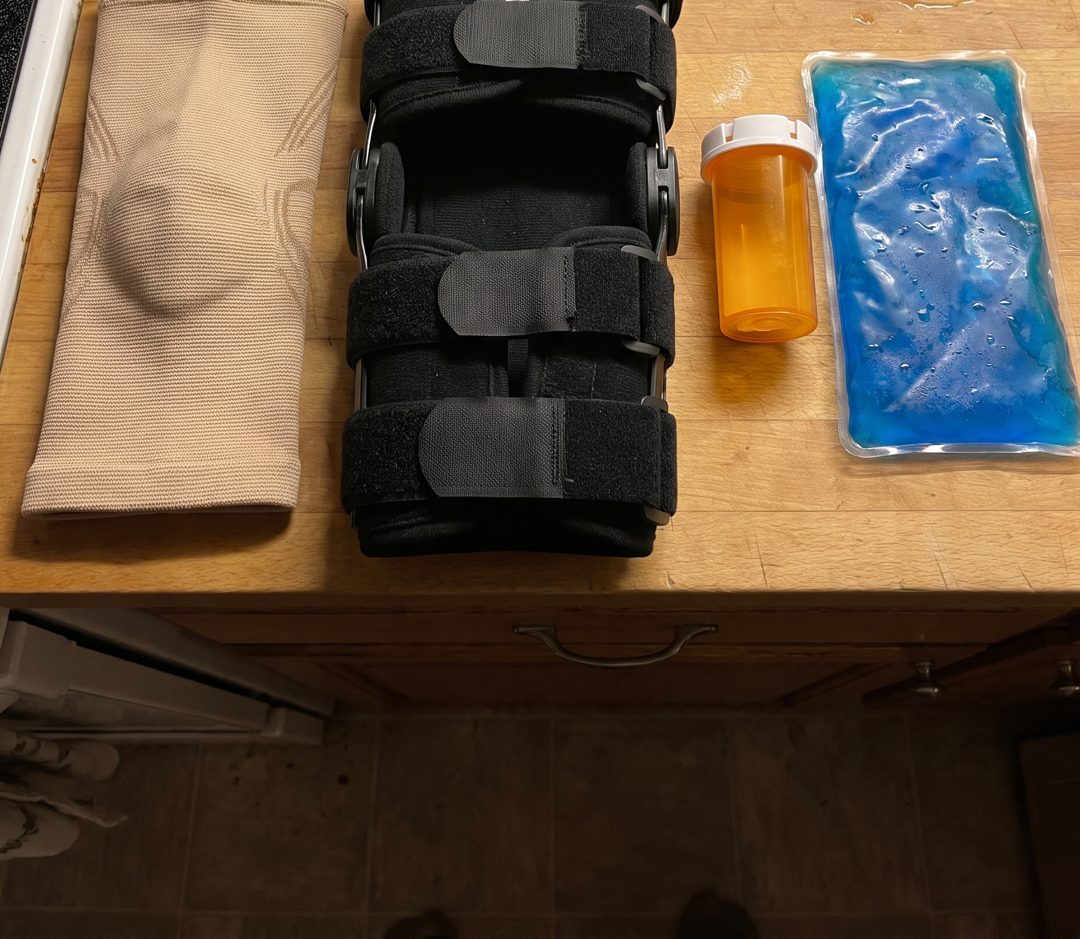
Lined up on the counter, I finally saw it. They all had the same flaw.
Every one of them was built on the same idea: cover the whole knee. More fabric, more support. Right?
Not really.
The problem wasn't me. It was the idea behind all of them.
See what finally worked instead →
Try This on Your Own Knee Right Now (10 Seconds)
My old work buddy showed me this over lunch. Try it.
Put your whole hand flat on your knee and press. You barely feel it.
Now press one finger just below your kneecap, with the same push. You feel that one right where it hurts.
Same push. One spot. That's the whole difference.
A sleeve is the flat hand. It squeezes everything a little, so the spot that hurts gets almost nothing.
A brace is the flat hand with hinges. It's built to hold the whole joint still, which is a different job.
What that one spot needed was the finger.
That idea has a name. It's called the One-Point Rule: put the pressure on the one spot taking the load, and leave the rest of the knee alone.
What a Cleveland Clinic Doctor Says About That Spot
I wanted to know if this was real or just a nice story. So I looked it up.
Dr. Dominic King, DO, a sports medicine physician at the Cleveland Clinic, explains how a patella strap works:
"The patella strap works by applying gentle pressure to the patellar tendon, which changes how force is distributed through the tendon."
That's the One-Point Rule. Press on that one spot, and the force going through it changes every time you step down.
A peer-reviewed study in the journal Sports Health found the same thing in its own way: patellar straps reduced the predicted strain on that tendon.
And Dr. King's own words about it stuck with me:
"It really is amazing what that little strap can do."
See the strap built on the One-Point Rule →
The Strap Was Smaller Than I Expected
Turns out my buddy had been wearing one on the golf course all season. It's called PinPoint, made by a company called Serevue.
It's not a sleeve, and it's not a brace. It's a thin strap with one molded pad that sits just below the kneecap.
The pad is molded, not soft fabric. So it holds its shape and keeps the pressure on that one point, instead of spreading it around like a sleeve does.
Everywhere else, the knee is left alone. Nothing wraps it. Nothing locks it.
If you can find your kneecap, you can put it on right the first time. Pad just below it. Tighten until it's snug. Done.
It went under my pants, and nobody could tell. Gary, 66, wears his to the office:
"Put it on Monday morning under my dress pants for work. By Tuesday I'd forgotten I was wearing it… Slim profile, no bulk, nobody can tell it's there."
Gary F., 66
What It Isn't
I'll be honest about this part.
No hinges, no metal, nothing rigid. It's not a brace. If your knee gives way or a doctor has told you to wear a rigid brace, this isn't that, and you should wear what they told you.
It's also not instead of the exercises I'd been given. What it did was let me keep moving while I did them, instead of booking another scenic drive.
And it's built for one kind of pain: the front of the knee, just below the kneecap, worst on the way down. That's the spot. That's the job.
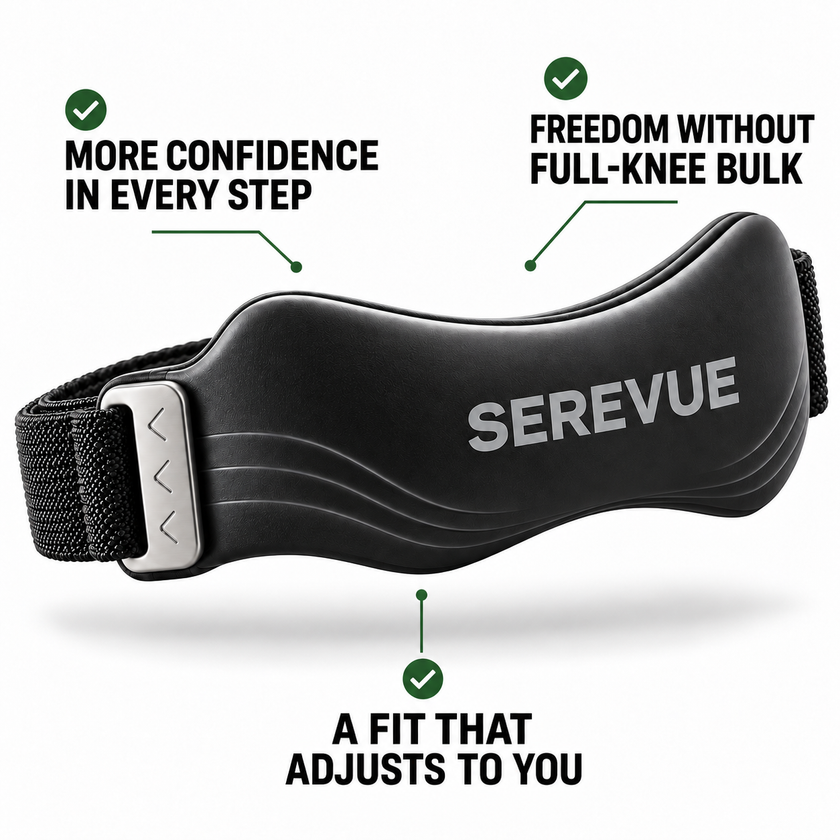
- One molded pad, just below the kneecap
- One adjustable size, either knee
- Fits under pants
- Buy 1 Get 1 Free right now
- 60 days to try it on your own stairs
Day 1, Day 3, Week 2, Week 4
Here's how it actually went. No miracle on day one. Something better.
Day 1. I went for a walk around the block. I didn't feel a miracle. What I noticed was what wasn't there. No bunching. No heat. No stopping to yank it back up.
Day 3. I took the stairs down to the basement and didn't grab the railing. I only noticed when I got to the bottom. Going down. The part that always found it.
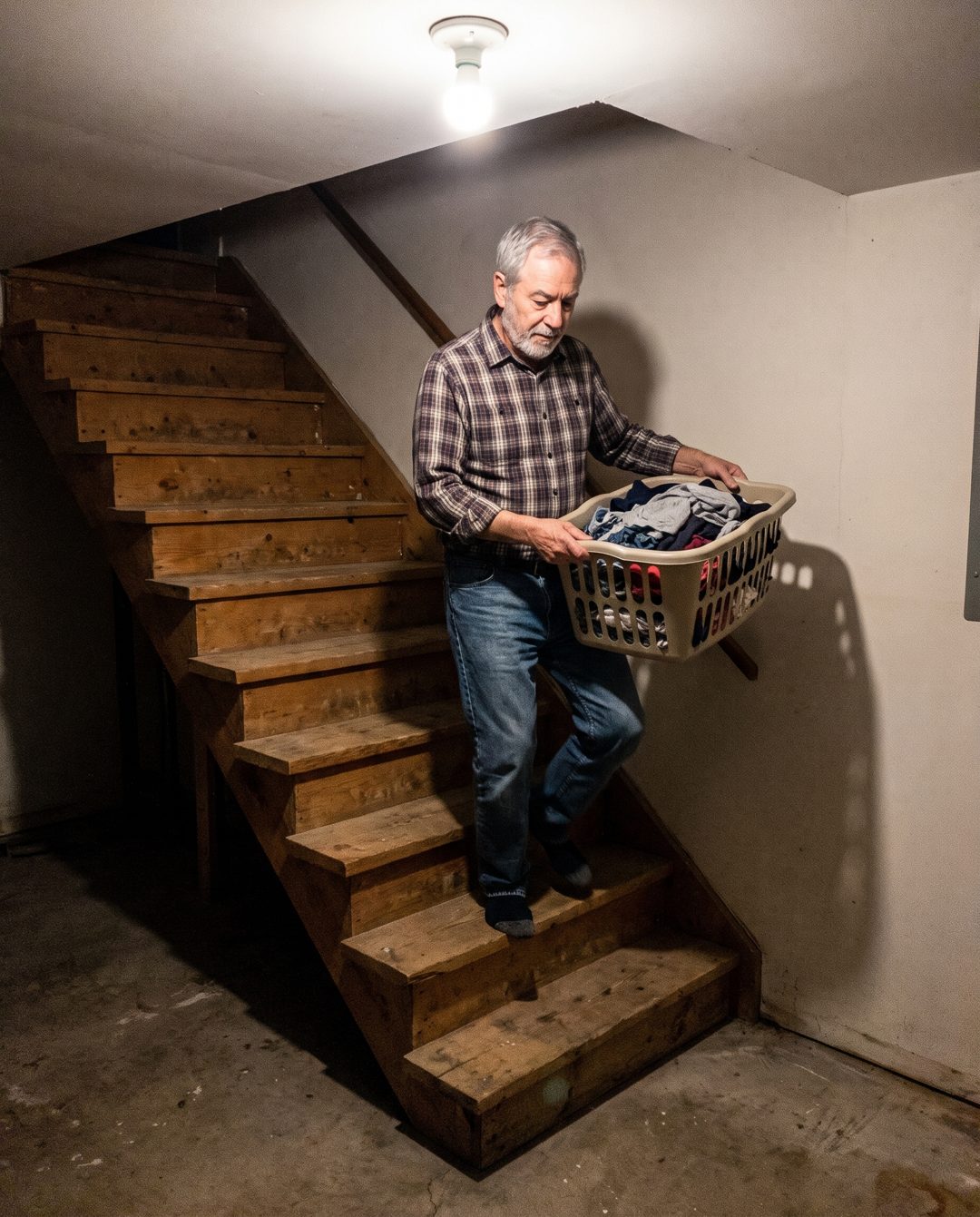
Week 2. I realized I'd stopped planning my days around my knee. I wasn't picking the route with fewer steps anymore.
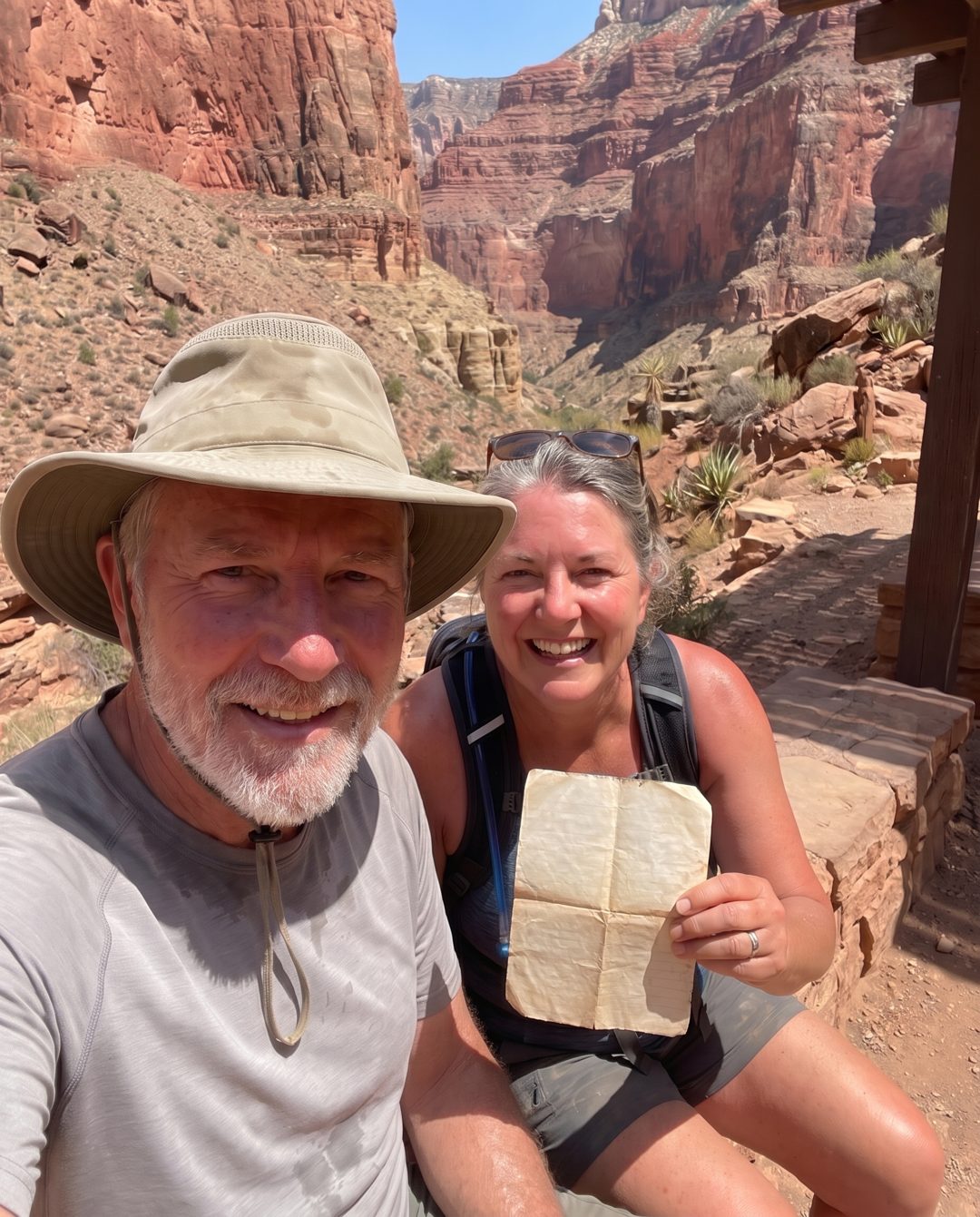
Week 4. We didn't stop at the rim this time. Ellen and I hiked down the Bright Angel Trail. Three miles, every step of it downhill. Then back up.
At the 3-Mile Resthouse, Ellen pulled the old list out of her pack. The one I'd taken off the fridge. She'd kept it.
Thomas, 67, wrote in about a trip a lot like ours:
"Coming downhill into the villages was where I struggled most. I wore the Pinpoint strap every day of the trip and made every excursion without once asking the group to slow down."
Thomas H., 67
Is It Built for Your Knee? Three Quick Checks
PinPoint is made for one pattern. Check yourself:
- The pain is at the front of the knee, just below the kneecap.
- It's worse going down stairs, curbs or hills than going up.
- It's worse getting up from a low chair or off the floor.
If that's you, it's built for exactly that spot.
Right now Serevue, the company that makes PinPoint, is running Buy 1 Get 1 Free, so it's $44.90 for two.
Most people use the second one for the other knee. Or keep one drying out in the travel bag while they wear the other. On a long trip, that matters.
That's about 12 cents a day for a year, for two of them.
And you don't have to decide today. You get 60 days to try it on your own stairs. If it's not for you, you get a full refund.
Two Choices
Here's how I see it.
You can keep shrinking the plans and calling it realistic. I did that for a year, and I won't get that year of scenic drives back.
Or you can try the One-Point Rule on your own knee, on your own stairs, for 60 days.
The list is back on our fridge. One line crossed off. The Camino is next fall.
P.S. You worked a long time for this chapter. Don't live the smaller version of it. Sixty days on your own stairs will tell you which line you cross off first.